G-Amp-HT℠ High-Throughput NGS Genotyping
In the cell and gene therapy (CGT) industry, rapid genotyping characterization after gene editing is critical, not only for single-cell clone selection, but whenever the same editing modality is run across many samples.
Traditional methods create bottlenecks with slow turnaround, limited throughput, and resolution that is too coarse for low-frequency alleles. Teams then face a false choice: stay cheap and fast but miss mixed populations, or move every sample onto deep, costly NGS that may be over-qualified for screening purposes.
But it does not have to be an either-or choice.
G-Amp-HT℠ from GeneGoCell is the new high-throughput member of the Genome Editing Verification (GEV℠) suite. It is positioned as an upgraded replacement of G-Screen℠: same turnaround time, same cost, and substantially better analytical quality, resolving allele frequency as low as 1%, versus approximately 5–15% for G-Screen℠.
Minimum submission is 24 samples. That combination makes G-Amp-HT℠ practical for clone grids and for any multi-sample study that uses the same editor and guide design across a plate, donor set, or process panel.
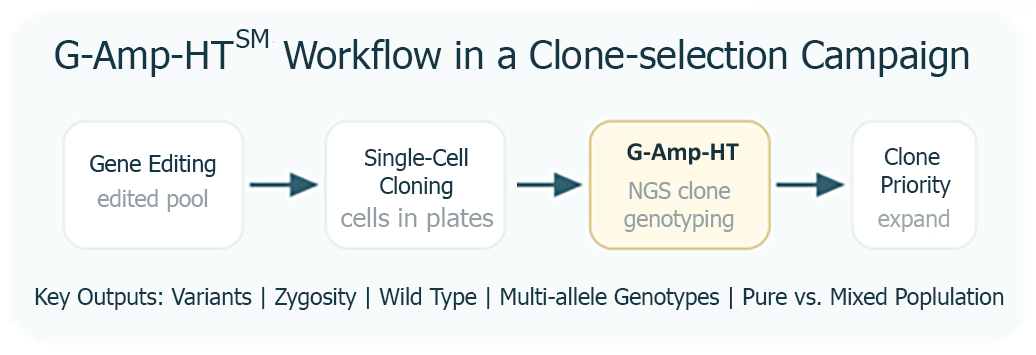
G-Amp-HT℠ workflow in a clone-selection campaign: Gene Editing → Single-Cell Cloning → G-Amp-HT℠ NGS Clone Genotyping → Clone Prioritization.
The Challenge: Throughput Without Enough Resolution
Gene editing projects in CGT and cell-based manufacturing frequently face extended screening timelines, high labor and reagent costs, and ambiguous genotyping.
G-Screen℠ solved the throughput problem for clone genotyping: multi-well formats, low cell input, and reports in under a week. For many programs, though, a 5–15% allele-frequency floor is sometimes not enough. Mixed clones, incomplete editing, and low-abundance alleles can sit below that cutoff and still matter for clone advancement, process decisions, or multi-sample QC.
At the other end of the GEV℠ suite, G-Amp℠ delivers UMI-enabled, dual-amplicon verification to 0.01% allele frequency, which is the right tool for on- and off-target confirmation and IND-ready panels, but not always the right economics when the question is:
“Screen 96 wells of the same edit quickly.”
G-Amp-HT℠, an upgraded version of G-Screen℠, is specifically designed to close this gap.
G-Amp-HT℠: High-Throughput Genotyping at 1% Allele Frequency
G-Amp-HT℠ brings G-Amp℠ chemistry and analysis discipline into a high-throughput format designed for many samples of the same editing modality.
It genotypes insertions, deletions, substitutions, and related outcomes while reporting allele frequency with a practical resolution as low as 1% AF—a clear upgrade from G-Screen℠ (5–15% AF)—without changing turnaround time or price.
What It Means in Practice
- Substantially improved resolution over G-Screen℠: Resolve allele frequency as low as 1% AF versus approximately 5–15% AF, providing clearer resolution for complex editing or clonal genotyping.
- Same cost as G-Screen℠: Teams can raise resolution without moving every sample to high-resolution NGS.
- Same TAT as G-Screen℠: Sample receipt to customized report typically under 1 week, and as fast as 3 days.
- High throughput and low input: Multi-well formats with minimal starting material—as few as 500 cells per well on 96-well, 48-well, or 24-well plates.
- Minimum 24 samples per submission: Built for plate-scale and multi-sample studies rather than one-off complex panels.
Clone Screening and More: Same Edit, Many Samples
Clone grids remain a primary use case.
G-Amp-HT℠ also fits applications where the same editing modality is applied across multiple samples and the decision depends on editing outcomes at approximately 1% allele frequency, with a minimum of 24 samples.
Examples include:
- Multi-allele cell line engineering: For example, CHO engineering banks with large clone collections.
- Single-cell clone genotyping and quick purity checks: Following CRISPR or other nuclease editing—the classic G-Screen℠ workflow, now at 1% AF.
- Guide or condition screens: The same nuclease class across multiple gRNAs, doses, or electroporation settings.
- Process-development dosing: Titration of RNP, mRNA, or viral dose across replicates to identify a manufacturing window.
- Donor-to-donor or lot-to-lot comparability: The same intended edit across multiple primary-cell donors or production lots.
- Time-course or replicate panels: Multiple wells of the same edit sampled across time points or biological replicates.
- Pool-to-clone triage: Increase resolution on intermediate pools or pre-clones before committing to G-Amp℠ confirmation with sensitivity as low as 0.01% AF.
G-Amp-HT℠ is the bridge that keeps screening clean at 1% AF with minimal NGS cost.
G-Amp-HT℠ Workflow: Efficient End-to-End Multi-Sample Genotyping
The process is designed for simplicity and speed:
- Client site: Prepare samples—typically multi-well plates at low confluence for clone work—and ship frozen plates or other agreed formats to GeneGoCell. Plan for a minimum of 24 samples.
- Sample receipt: GeneGoCell receives samples and initiates processing.
- High-throughput NGS genotyping and analysis: Sequencing and variant analysis with allele-frequency reporting to 1% AF.
- Results delivered: Customized reports covering genotype, allele frequency, purity/zygosity where applicable, and annotations.
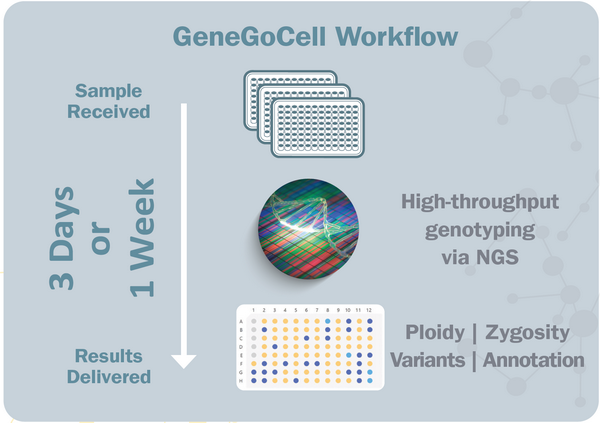
From sample receipt to high-throughput NGS genotyping and customized results, with turnaround as fast as 3 days and typically within 1 week.
This workflow minimizes hands-on time for your team while delivering higher-resolution data than G-Screen℠ at the same operational cadence.
G-Screen℠ at Higher Resolution—with the Same Cost and TAT
A February 2026 publication in Biotechnology Progress, “Evaluation of gene editing in CHO cells using the Cas-CLOVER system,” showed how high-throughput NGS clone genotyping supports cell-line engineering.
Researchers at Sanofi used G-Screen℠ for accurate single-cell clone genotyping, purity, zygosity, and editing outcomes in a CHO setting foundational to biologics and many CGT manufacturing processes (PubMed 41656178).
That study illustrates the demand G-Amp-HT℠ is built for: large clone or multi-sample collections that need speed and cost discipline, plus enough allele-frequency resolution to identify mixed or incomplete edits that coarser screens may miss.
Programs that already run G-Screen℠-style plates can seamlessly move to G-Amp-HT℠ with upgraded 1% AF resolution at the same TAT and cost.
Why GeneGoCell for Genome Editing Verification in CGT
GeneGoCell, based in San Diego, CA, specializes in customized, GxP/CLIA-compliant, ISO/IEC-accredited NGS and flow cytometry solutions for CGT and genome editing.
G-Amp-HT℠ for fast, high-throughput genotyping sits within the broader Genome Editing Verification (GEV℠) portfolio:
- G-Amp-HT℠ — high-throughput NGS genotyping
- G-Amp℠ — UMI-based dual-amplicon on- and off-target verification
- G-GUIDE℠ — licensed GUIDE-Seq genome-wide off-target identification
- G-Trans℠ — genome-wide translocation evaluation
- G-Int℠ — genome-wide integration analysis
Fast turnaround, expert project support, and compliant quality help clients move programs forward with purpose-fit assays for their specific analytical needs.
Ready to Explore G-Amp-HT℠?
Ready to see whether G-Amp-HT℠ fits your project?
Contact our team for a complimentary customized discussion with a GeneGoCell subject-matter expert.
Learn more about G-Amp-HT℠ and our proprietary Genome Editing Verification (GEV℠) platform.
GeneGoCell: Compliant. Customized. Responsive. Fast.
Let’s advance your gene-editing and CGT programs together.