Genome editing can achieve strong on-target activity while still creating rare cleavage events elsewhere in the genome. For CRISPR nuclease programs, identifying those unintended sites is an important part of understanding genotoxicity and designing an effective verification strategy. In silico prediction can prioritize likely off-target loci, but it cannot replace empirical measurement in edited cells. GUIDE-seq is a cell-based, next-generation sequencing (NGS) method for genome-wide nomination of nuclease-induced double-strand break sites. GeneGoCell’s licensed GUIDE-seq and optimized the workflow to G-GUIDE℠, which includes native-molecule unique molecular identifiers (UMIs), optimized workflow, custom bioinformatics, and sample-to-report project support. In its validated configuration, G-GUIDE℠ detects dsODN integrations at a limit of detection (LOD) of 0.005%, with a guaranteed under two-week turnaround.
Why Genome-Wide Off-Target Identification Is Challenging
Rare off-target events create a practical measurement problem. Whole-genome sequencing at the depth required to confidently detect extremely low-frequency editing events can become computationally and financially impractical. Targeted amplicon sequencing can achieve much deeper coverage, but it requires the candidate loci to be known in advance. A practical strategy therefore separates two analytical questions: first, where might unintended editing be occurring; second, how frequently does editing occur at those nominated sites? G-GUIDE℠ addresses the first question through genome-wide empirical site nomination, while targeted deep sequencing can address the second through focused verification and quantification.
How G-GUIDE℠ Identifies CRISPR Off-Target Sites
G-GUIDE℠ in principle works similarly to GUIDE-Seq, which uses a short double-stranded oligodeoxynucleotide (dsODN) tag that is co-delivered with the genome-editing machinery. When a nuclease generates a double-strand break (DSB), the dsODN can integrate at the break site. The integrated dsODN then serves as an anchor for semi-specific PCR enrichment. After NGS and bioinformatics analysis, dsODN-tagged genomic loci provide an empirical list of candidate cleavage sites for downstream review and confirmation. The original GUIDE-seq method reported detection around a 0.1% level; GeneGoCell’s optimized G-GUIDE℠ workflow has been analytically validated to detect dsODN integrations at 0.005% in its validated configuration.
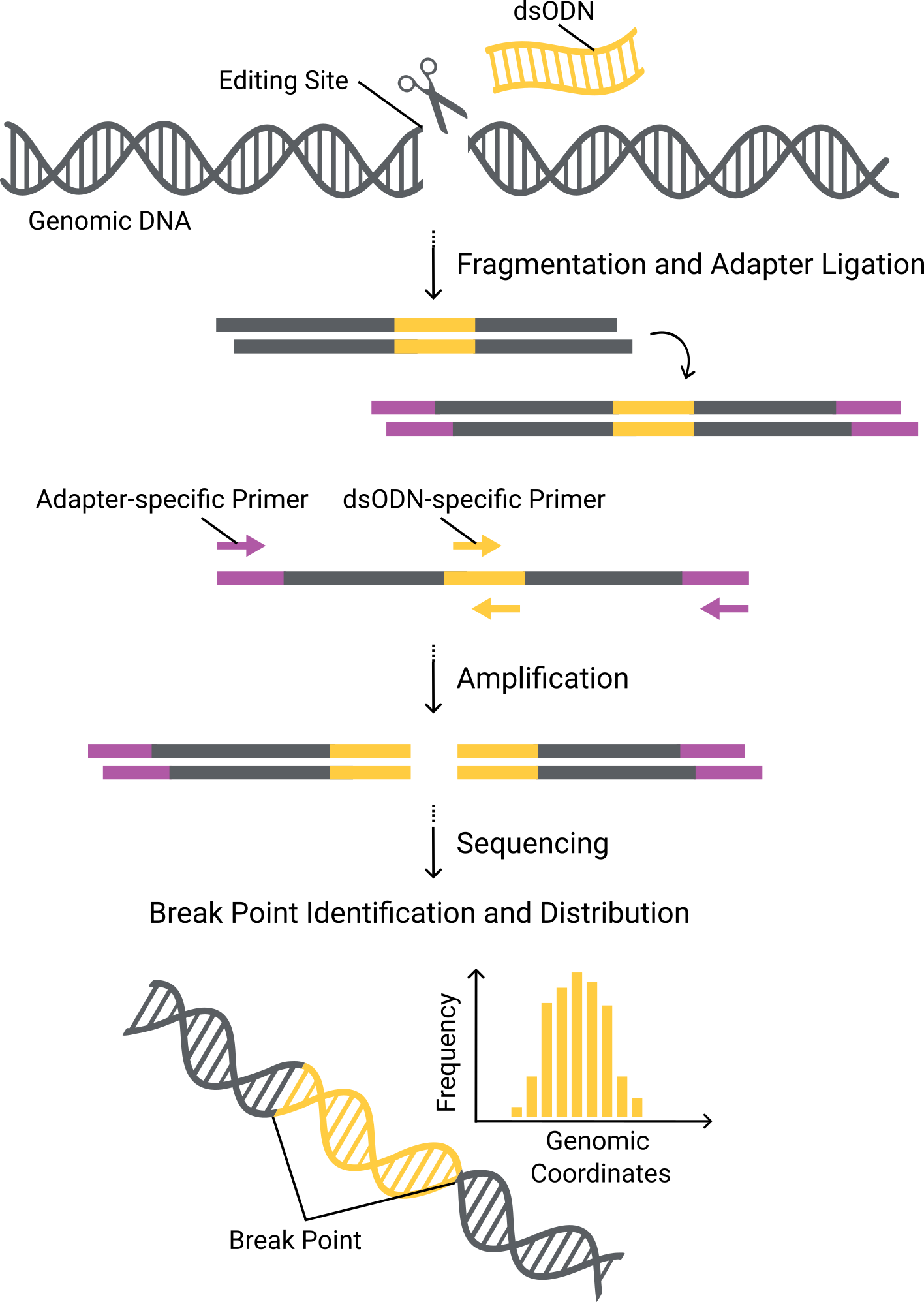
G-GUIDE℠: Validated 0.005% LOD with under Two-Week Turnaround
GeneGoCell provides optimized, pre-annealed, ready-to-use dsODNs for client experiments. After dsODN-treated samples are submitted, the G-GUIDE℠ workflow includes library preparation, sequencing, custom bioinformatics analysis, and reporting in GeneGoCell’s CLIA/CDPH-certified, GxP-compliant, ISO/IEC 17025:2017-accredited laboratory. The final report lists and characterizes dsODN integration sites in each sample. For teams balancing sensitivity with development timelines, the combination of a validated 0.005% LOD and guaranteed two-week turnaround can make genome-wide off-target nomination easier to incorporate into an active genome-editing program.
Native-Molecule UMIs Improve Confidence in Low-Frequency Calls
PCR-based enrichment can introduce amplification bias, which becomes increasingly important when rare events are being measured. G-GUIDE℠ incorporates unique molecular identifiers (UMIs) so that original genomic DNA molecules can be tracked through amplification and analysis. In G-GUIDE℠, molecular barcoding is applied to native molecules rather than only to amplified products. This approach is designed to minimize PCR-related bias, reduce false-positive integration calls, and support more confident quantification and characterization of candidate off-target sites.
Performance Across Diverse Cell Types and Nuclease Platforms
Off-target nomination performance depends on the biological system, including cell type, guide, nuclease, editing efficiency, and dsODN incorporation. G-GUIDE℠ has generated high-quality datasets across diverse systems, including primary T cells, B cells, HEK293T cells, iPSCs, HSCs, and primary hepatocytes, as well as multiple nuclease platforms. In a representative primary T-cell setting with dsODN integration rates ranging from approximately 1% to 15%, G-GUIDE℠ generated more than 200,000 UMI-tagged on-target reads and detected off-target integrations at frequencies as low as 0.005%. High-quality genome-wide off-target datasets have also been generated from more challenging samples with dsODN integration rates as low as 0.2%.
From Off-Target Nomination to Verification with G-Amp℠
Genome-wide nomination is only the first step. Once G-GUIDE℠ produces a list of candidate off-target sites, those loci can be combined with relevant in silico predictions and verified by targeted deep sequencing. GeneGoCell’s G-Amp℠ workflow provides UMI-based targeted on- and off-target verification. Custom panels can cover approximately 10 to 400+ potential off-target sites for research-use-only testing, allowing teams to move from unbiased site nomination to deeper, locus-specific confirmation and quantification.
Where G-GUIDE℠ Fits in Current Genome-Editing Safety Assessment
FDA’s January 2024 final guidance for human gene therapy products incorporating genome editing addresses product design, manufacturing and testing, nonclinical safety assessment, and clinical-trial design. FDA’s April 2026 draft guidance adds specific recommendations for NGS-based methods used to evaluate off-target editing and loss of genome integrity in nonclinical studies supporting genome-editing products. The practical implication is that off-target site nomination and site-specific confirmation should be treated as distinct but complementary analytical tasks. A cell-based method such as G-GUIDE℠ can contribute to empirical nomination for nuclease-based editing programs, while targeted sequencing can provide deeper confirmation at nominated sites. No single assay should be presented as satisfying every genome-editing safety question for every product.
A Sample-to-Report Workflow for Genome Editing Verification
Off-target studies are highly project-specific. GeneGoCell supports experimental planning, dsODN strategy, sample submission, sequencing, bioinformatics analysis, and reporting through a single project workflow. A dedicated project manager coordinates each project from start to finish, helping technical, quality, and program teams maintain visibility while the analytical work is completed.

Frequently Asked Questions About G-GUIDE℠ Off-Target Analysis
What is G-GUIDE℠ used for? G-GUIDE℠ is a licensed and optimized version of GUIDE-seq, which is a cell-based NGS method used to nominate genome-wide sites of nuclease-induced double-strand breaks. In CRISPR programs, it is used to identify candidate off-target cleavage sites for further investigation.
What is the validated detection limit of G-GUIDE℠? GeneGoCell’s G-GUIDE℠ workflow has been analytically validated to detect dsODN integrations at an LOD of 0.005% in its validated configuration.
How is G-GUIDE℠ different from the original GUIDE-seq workflow? G-GUIDE℠ is GeneGoCell’s licensed and optimized GUIDE-seq workflow. Key features include native-molecule UMI barcoding, an improved version of dsODN, an optimized library preparation workflow, as well as a re-written analysis algorithm. The combination of these has enabled a validated 0.005% LOD, which is far more sensitivity than the original published GUIDE-Seq.
Can G-GUIDE℠ results be verified by targeted NGS? Yes. Candidate loci nominated by G-GUIDE℠ can be combined with in silico-predicted sites and verified using targeted deep sequencing such as GeneGoCell’s UMI-based G-Amp℠ workflow.
Which cell types can be used with G-GUIDE℠? G-GUIDE℠ has generated high-quality datasets in multiple cell types, including primary T cells, B cells, HEK293T cells, iPSCs, HSCs, and primary hepatocytes. Project feasibility depends on the specific editing system and dsODN incorporation performance.
About GeneGoCell
GeneGoCell, Inc. is a San Diego-based NGS testing laboratory supporting genome-editing and cell and gene therapy programs. GeneGoCell provides Genome Editing Verification (GEV℠) workflows for genome-wide off-target identification, targeted on- and off-target verification, translocation analysis, integration analysis, and other customized NGS applications. Testing is supported by a CLIA/CDPH-certified, GxP-compliant, ISO/IEC 17025:2017-accredited laboratory and dedicated scientific project management.
Start Your G-GUIDE℠ Project
If you are planning a CRISPR off-target study, GeneGoCell can help review your editing system, dsODN strategy, sample requirements, and downstream verification plan. Learn more about GeneGoCell’s Genome Editing Verification (GEV℠) services, or contact info@genegocell.com for a project-specific discussion.
References
-
Tsai SQ, et al. GUIDE-seq enables genome-wide profiling of off-target cleavage by CRISPR-Cas nucleases. Nature Biotechnology. 2015;33(2):187-197.
-
Nobles CL, et al. iGUIDE: an improved pipeline for analyzing CRISPR cleavage specificity. Genome Biology. 2019;20(1):14.
-
U.S. Food and Drug Administration. Human Gene Therapy Products Incorporating Human Genome Editing: Guidance for Industry. January 2024.
-
U.S. Food and Drug Administration. Safety Assessment of Genome Editing in Human Gene Therapy Products Using Next-Generation Sequencing: Draft Guidance for Industry. April 2026. Draft; not for implementation.