Genome editing can create unintended outcomes ranging from small sequence changes and off-target edits to large structural rearrangements and unintended DNA integration. Comprehensive genome-editing verification therefore requires analytical approaches matched to the specific type and scale of genomic change. For cell and gene therapy programs, integration-related events are particularly important because unintended integration, altered integration patterns, or compromised transgene integrity may affect product quality, function, and long-term safety. Sensitive and reliable next-generation sequencing (NGS) analysis is therefore essential for characterizing these risks and generating data that support informed development decisions. As regulatory attention to genomic integrity and potential long-term genotoxicity continues to increase, developers need analytical strategies capable of answering specific integration questions without relying exclusively on whole-genome sequencing at ultra-high depth, which may be impractical for routine, high-sensitivity characterization.
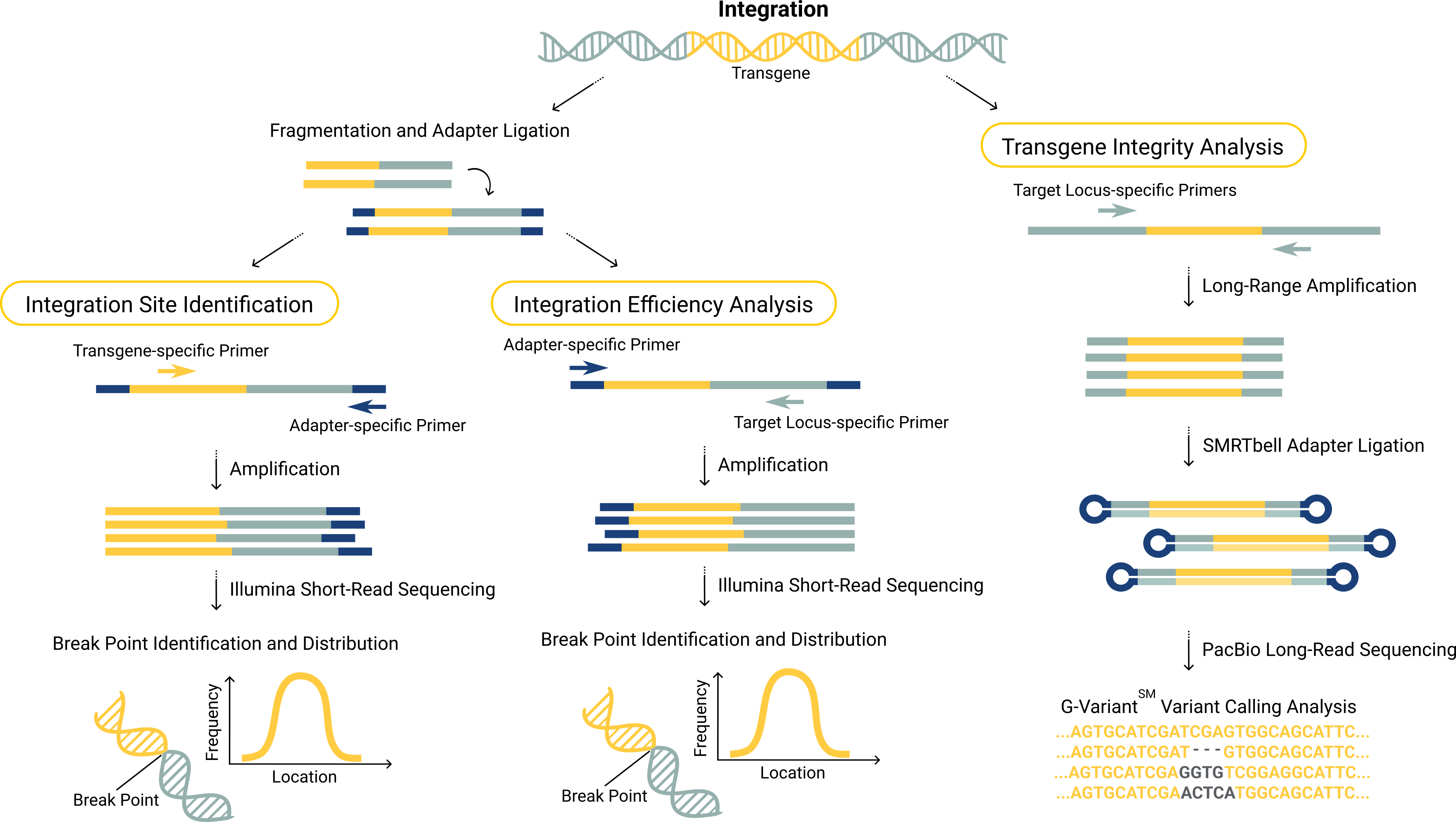
GeneGoCell’s Genome Editing Verification (GEV℠) G-Int℠ platform addresses the needs of analyzing both intended and unintended integration events through three complementary analytical approaches: Integration Site Identification, Integration Efficiency Analysis, and Transgene Integrity Analysis. Together, these workflows are designed to determine where integration has occurred, quantify the extent of integration, and evaluate the structural integrity of the introduced transgene. G-Int℠ provides a sample-to-report solution encompassing assay design, sample preparation, sequencing, customized bioinformatics, and reporting. The platform is designed for accuracy, flexibility, scalability, and efficient project execution, with sample testing completed within a guaranteed two-week turnaround time.
Figure 1. G-Int℠ workflow Illustration
G-Int-Site℠: Integration Site Identification
Many genome-editing and gene-delivery systems may involve intended or unintended integration events. For example, when AAV is used as a delivery vehicle, unintended integration could take place. Or when a lentiviral transduction is involved, host genome integration is expected at random genomic loci. Even during targeted integration through homology-directed repair (HDR), unintended insertion may occur at on-target or off-target editing sites. As a result, a genome-wide method to identify integration sites is necessary to determine the genomic coordinates and distribution of integration events.
G-Int-Site℠ assay utilizes ligation-mediated PCR, semi-specific target-amplification sequencing to identify genome-wide integration or insertion events associated with the editing of target-of-interest.
G-Int-Site℠ incorporates unique molecular IDs (UMIs) such that each original genomic copy of DNA captured in a sample is barcoded once with a UMI, enabling for accurate quantification and tracking during data analysis and supporting more accurate quantification. This approach improves estimation of the relative abundance of integration events across different integration sites.
G-Int-Efficiency℠: Integration Efficiency Analysis
Regardless of intended or unintended integration or insertion events, an accurate determination of integration efficiency is crucial to evaluate editing performance and potential impact of integration events.
For integration system with short or no homologous arm, G-Int-Efficiency℠ assay utilizes ligation-mediated PCR, semi-specific target-amplification sequencing to determine integration efficiency at any given target site. This approach is applicable to integration systems such as viral (lentiviral vector, AAV, etc.) integration and transposon-mediated integration.
For integration system with long homology arms, e.g. HDR-mediated integration, depending on the size of homologous arm and transgene, G-Int-Efficiency℠ assay may use a combination of long-range amplicon and multiplex amplicon approaches to determine the relative abundance of integrated vs. wild type (WT) alleles. UMIs are incorporated into the assay to help account for PCR amplification-introduced bias.
G-Int-Integrity℠: Transgene Integrity Analysis
Once a transgene is delivered into the target site, it is important to assess its structural integrity of the transgene to determine whether the full-length sequence of the transgene has been integrated and whether sequence variants or structural alterations were introduced during the integration process.
G-Int-Integrity℠ uses long-range PCR to amplify the entire transgene region, followed by PacBio long-range sequencing in HiFi mode by default, or optional long-read mode, when appropriate. UMIs are incorporated during the amplification process to minimize PCR bias introduced by the size difference of amplicons.
Expert Project Support from Start to Finish
At GeneGoCell, we understand the unique needs of our clients when it comes to their proprietary technologies and platforms. That’s why we customize every project to meet your unique goals: From experimental design to data analysis and reporting. Our dedicated team of experienced project managers, scientists, and bioinformaticians collaborates to provide seamless, sample-to-report support for each project.

About GeneGoCell, Inc.
As a GxP/CLIA-compliant, ISO/IEC 17025:2017-accredited laboratory based in San Diego, we are deeply committed to highest standards of data integrity and regulatory readiness. With a proven track record of quality and scientific rigor, we have supported over 100+ clients globally. Our testing and results have been used in 30+ successful IND filing packages. Our team is currently providing GxP-compliant lot-release testing for 10+ clinical trial programs. Our experienced project managers work closely with you, providing sample-to-report support and ensuring that every step is aligned with your program’s specific goals and compliance needs
Wherever you are in your development journey, we’re here to provide reliable, high-quality Genome-Editing Verification (GEV)℠ support.
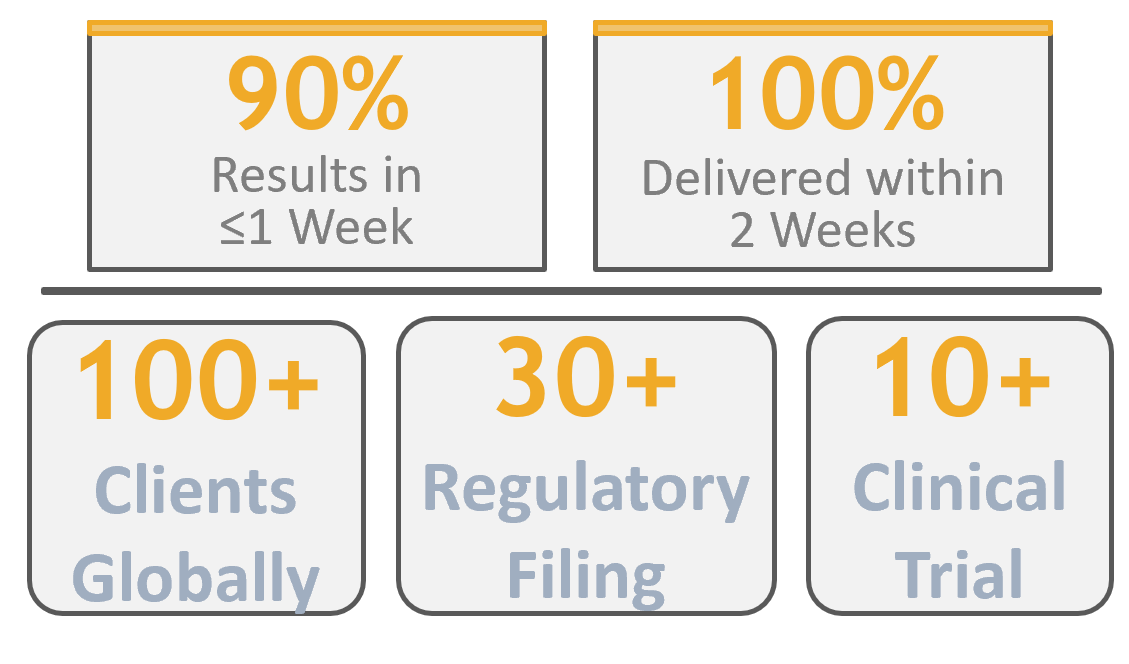
GEV℠ doesn’t have to be complicated. We’ve streamlined the process from start to finish, with quick onboarding, minimal hands-on time for your team, and predictable project timelines (results delivered in as little as 3 days). Our experts handle the details so you can stay focused on your research and development goals.
Contact our team for a complimentary consultation with our SME for G-Int Panel feasibility review, discuss your G-Int Panel, get a customized testing plan or request a quote. We are happy to share the technical White Paper about our G-Int℠ upon request.
Learn more about G-Int℠ and how GeneGoCell’s GEV℠ platform can be tailored to your specific program needs.
Disclaimer: All Rights Reserved. All content (text, images, code) described by GeneGoCell is copyright of GeneGoCell, Inc unless specifically stated. GeneGoCell is a GxP/CLIA-compliant, ISO/IEC 17025:2017 accredited, (CFR Title 21 Part 58) testing company.